Particular Peoples, Particular Places, and Particular Dead
Following a meme, I asked Grok to depict the world if I were in charge, and it came up with this as part of its analysis:
A world run on that temperament would not look like a rally or a glass-and-steel UN plaza. It would look like a place that decided particular peoples, particular places, and particular dead matter more than abstract Humanity. Stone that remembers. Streets that assume a shared grammar. Borders treated as load-bearing walls, not decorations. Civic architecture that behaves like a tomb: it is for the living because it is also for those who already passed through.
Initially I just thought it was a funny phrase. A bit of over-anchoring on my gloomy nom de tweet. But it stuck in my head. And as I thought about it more, I realized that there’s something to it.
My mother was born during WWII. She grew up without a father, because he died in Africa in 1943. He had been clearing mines in Tunisia after the victory against Rommel. My grandmother re-married after the war and my mother’s relationship with her stepfather was always strained.
My father, born just after the end of the war, is named after his uncle who died in a submarine at the end of 1942. A picture of this uncle used to hang in my grandfather’s house. I recall it being pointed out to me when I was a child too young to really understand its significance, but it quietly haunted me nonetheless.
There’s a version of Remembrance Sunday that talks about remembering the sacrifice of those who served, and at the same time strenuously avoids talking about what they fought for, except to use the most vague of abstract nouns: “Freedom!”, “Democracy!”, “Our way of life!”. And perhaps that’s reasonable in some sense. We can’t look into the hearts of the dead. My mother never got to know her father, so I can’t say with any certainty what made him fight, nor how he felt about it. And indeed, who can say exactly what “our way of life” is? This is precisely the particular which can’t be adequately described. Reportedly, when asked why he had enlisted to fight in WWI, the poet Edward Thomas picked up a handful of earth and said, “literally, for this.”
But sometimes this difficulty of saying why one should fight gets pressed into a generic “war is bad” framing. There’s this idea that wars just happen and soldiers are merely caught up in them. And sure, war is bad, but it might sometimes be necessary and worthwhile. Carried to an extreme, the implication of this thinking is that these people died for nothing. There’s something rather distasteful about that, and while I can’t say for sure, I strongly suspect that that’s not what my grandfather would have felt.
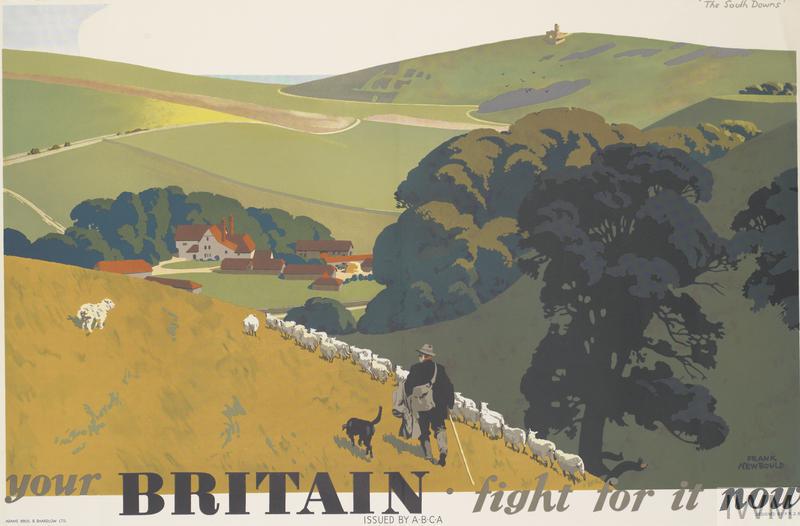
Frank Newbould
Your Britain: Fight for it now (The South Downs), 1942.
And indeed, I’m not at all sure that my grandfather would have died for abstract “Freedom!” and “Democracy!”, either. God forbid, war might be necessary and worthwhile even without our favourite abstract nouns. When the government wanted people to fight, they didn’t sell it with those words. Instead they produced posters with the slogan, “Your Britain. Fight for it now.” What “your Britain” meant to those who served may have been a private, personal thing. The effectiveness comes from the fact that you can read into it exactly what Britain means to you in all its particularity.
By way of a credit, I’d like to point to onsenregime’s thread on which politicians’ family names are recorded by the Commonwealth War Graves Commission. This post was much inspired by that. The family names of all four of my grandparents are amply represented in those records.